
Will going vegan really save the planet?
I’ve said it myself, as have many environmentalists over time: eat fewer animal products. And, I still stand by that. No, I don’t think 100% of people need to go 100% vegan. Not everyone can due to access or dietary restrictions or other factors. But, as much as we can, we should all try to reduce how many animal products we consume.
But why?
The impact of food on the planet
According to PubMed Central:
“Among all sectors, the food system accounts for a substantial use of natural resources and is a major contributor to the environmental degradation of planet Earth. It contributes 20–30% of total anthropogenic GHG emissions, accounts for 70% of all freshwater use, and is a major source of water pollution (6). About 80% of the world's deforestation is related to the food system, and this system is the leading cause of changes in land use and biodiversity loss (7). Without corrective measures, the environmental impact of the food system could increase by 50–90% in 30 years, reaching levels that are beyond the planetary boundaries.”
Yeah, our food systems are wasteful. Of course, we all need to eat. This is a necessary use of energy! Does that mean we should continue to operate as wastefully as possible? No. As PubMed states, we need corrective measures implemented to reduce our water use, energy use, and use of pesticides, just to name a few.
We won’t get into the nuances of food waste in this video, so learn more here before we move on to vegan and vegetarian food in particular next.
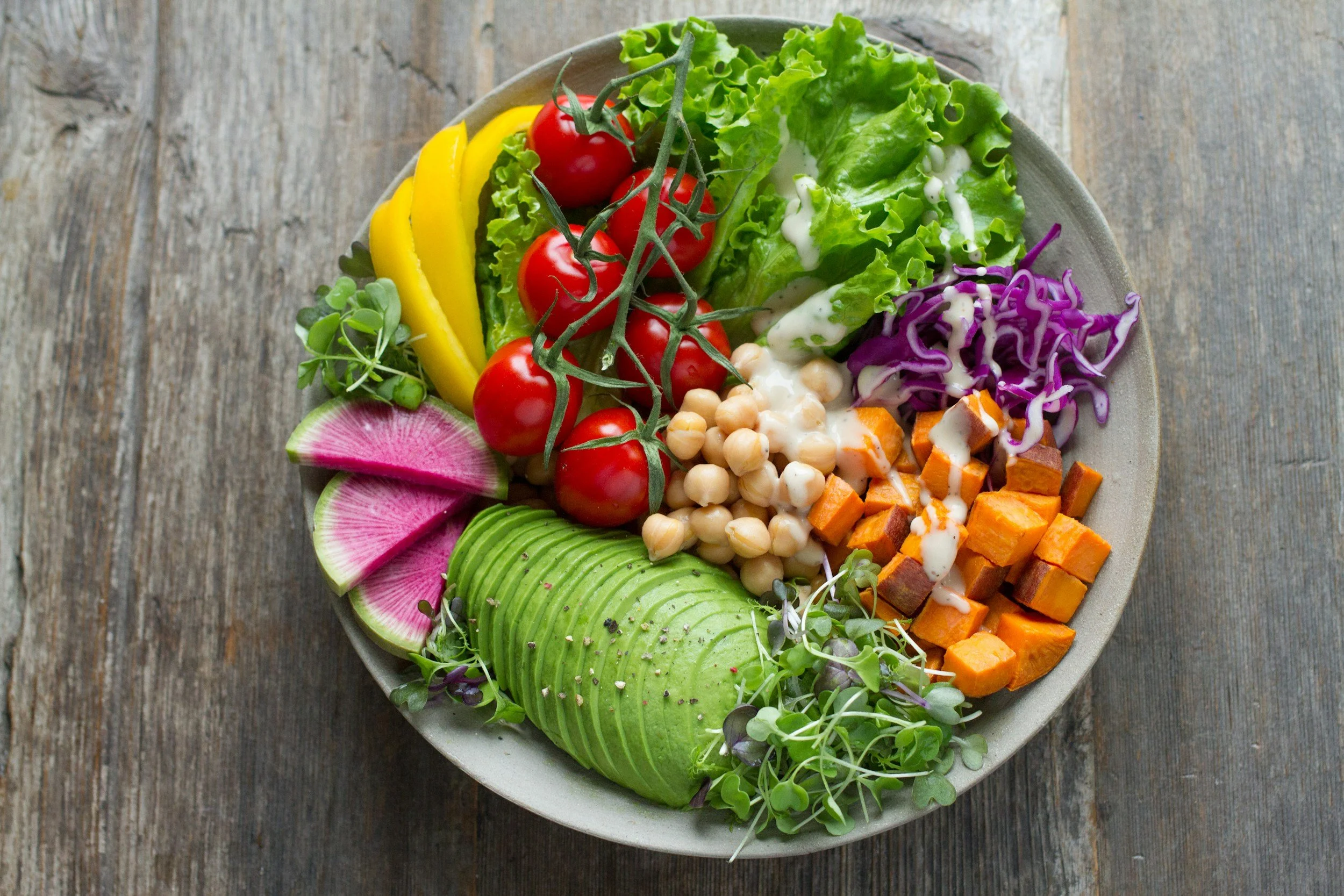
Image from Squarespace
What is a sustainable diet?
Again, according to PubMed Central:
“In 2010, the FAO indicated that other aspects of the diet, apart from its nutritional value, should be considered, such as its environmental sustainability. A “sustainable diet” is defined as a pattern ‘with low environmental impact that contributes to food and nutrition security and to healthy life for present and future generations. Sustainable diets are protective and respectful of biodiversity and ecosystems … nutritionally adequate, safe and healthy; while optimizing natural and human resources.’”
So, no, it’s not just a vegan diet that is sustainable. It matters where that food was grown, were pesticides and herbicides were used, how it was harvested, whether it was a monocrop that destroyed biodiversity, and many other things.
Vegans, hold your vegan horses. I’m not advocating for a meat-based diet. I’m just simply saying that there are many more factors that make a diet sustainable or not, beyond whether it was an animal or a plant that was consumed.
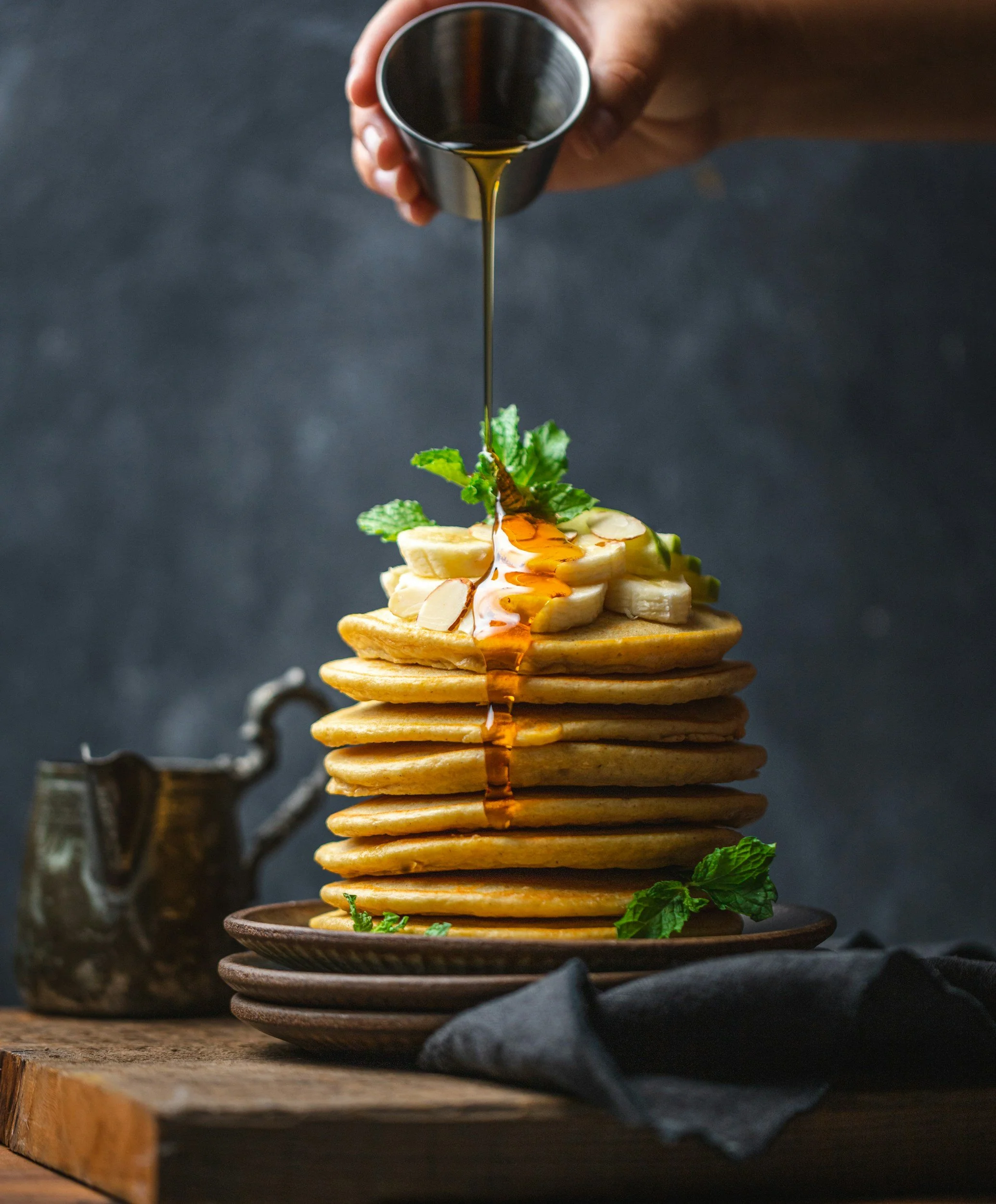
Image from Squarespace
Emissions
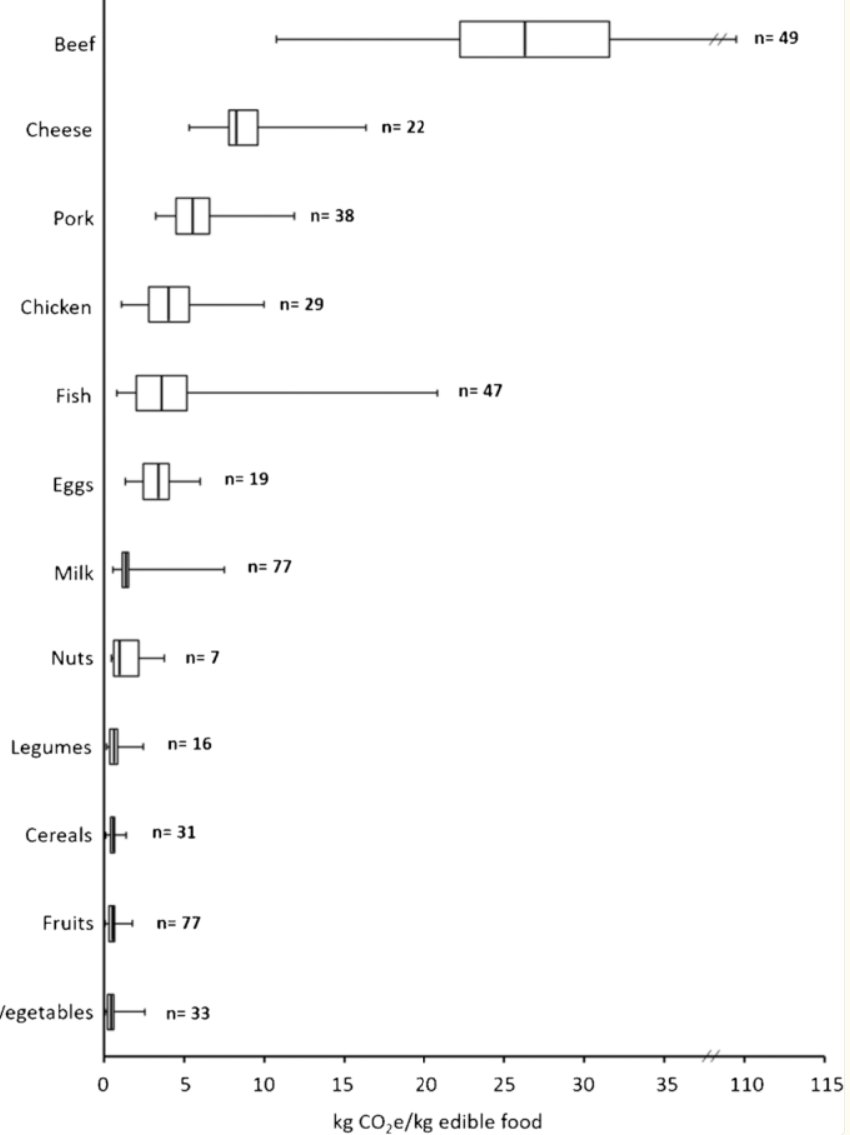
Okay, now let’s get vegan specific, starting with this chart that was adapted from Clune et al. 2017:
The ends of the boxes represent the outlying lows and highs, while the box itself represents the majority of data, with the middle line representing the average. This is greenhouse gas (GHG) emissions for each food type. It’s very clear that meat is the highest among human foods.
But why?
It boils down to a few points:
Animals produce methane emissions just by existing,
It requires tons of deforestation to make room for the animals to live and to grow the food that they need to eat,
They need to eat literal TONS of food and convert those plants into meat calories for us to eat, which is extremely inefficient,
And the large amounts of fertilizers used on these plants.
I already see the keyboard warriors in action: “bUt WoN’t ThOse eMIsSiOns oCcUr WhEn wE eAt The PLanTs, tOo?” Yes. Just on a much smaller scale. Hence why when we eat a vegetable, its carbon footprint is so low! We require much less food than a cow. When you eat a cow, your footprint is linked to all of that food they had to eat just to provide you with a 1/4 lb burger.
Water usage
According to PubMed Central, “food production is responsible for 70% of the total anthropogenic water use, and it is the major source of water pollution.”
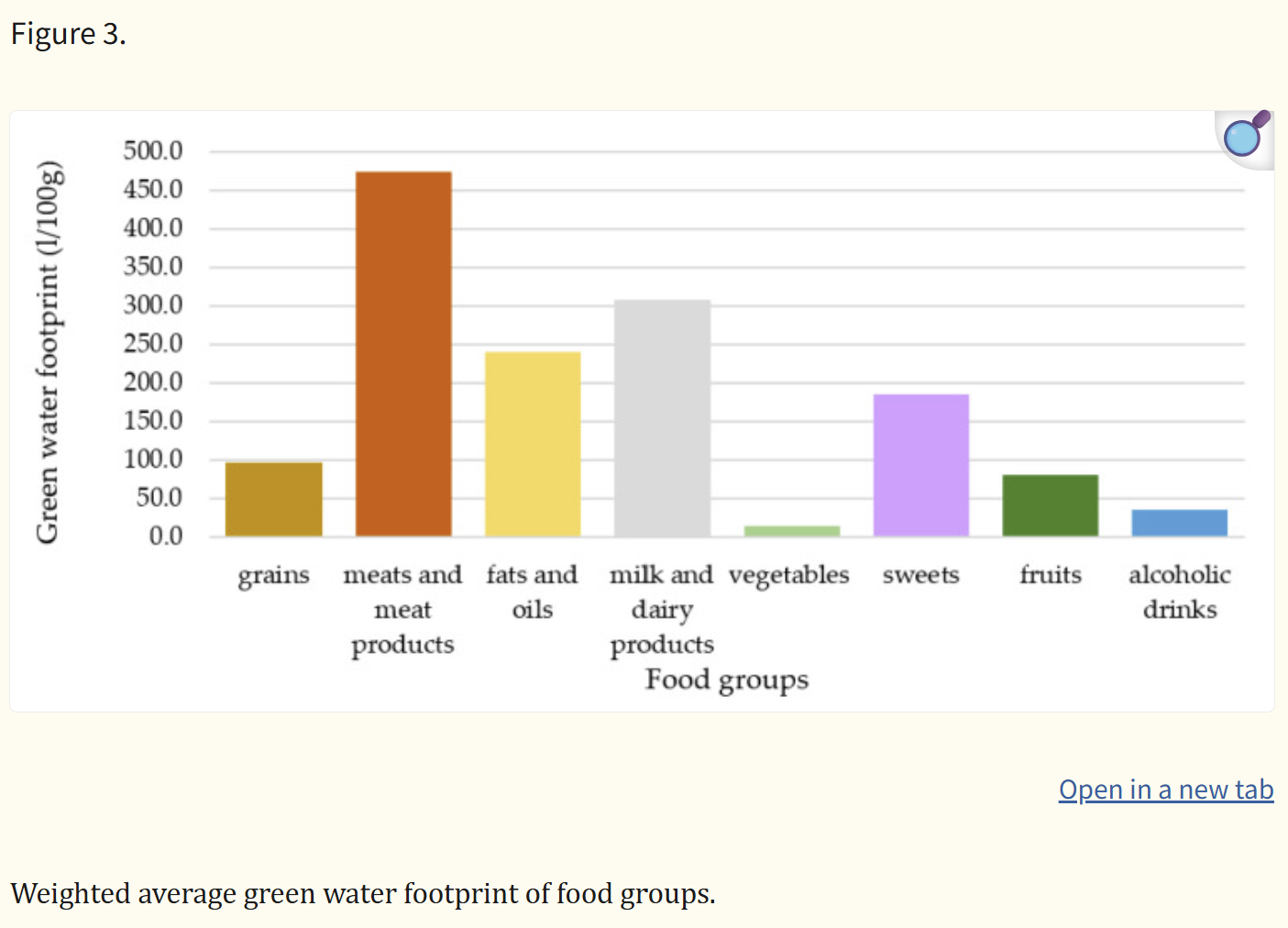
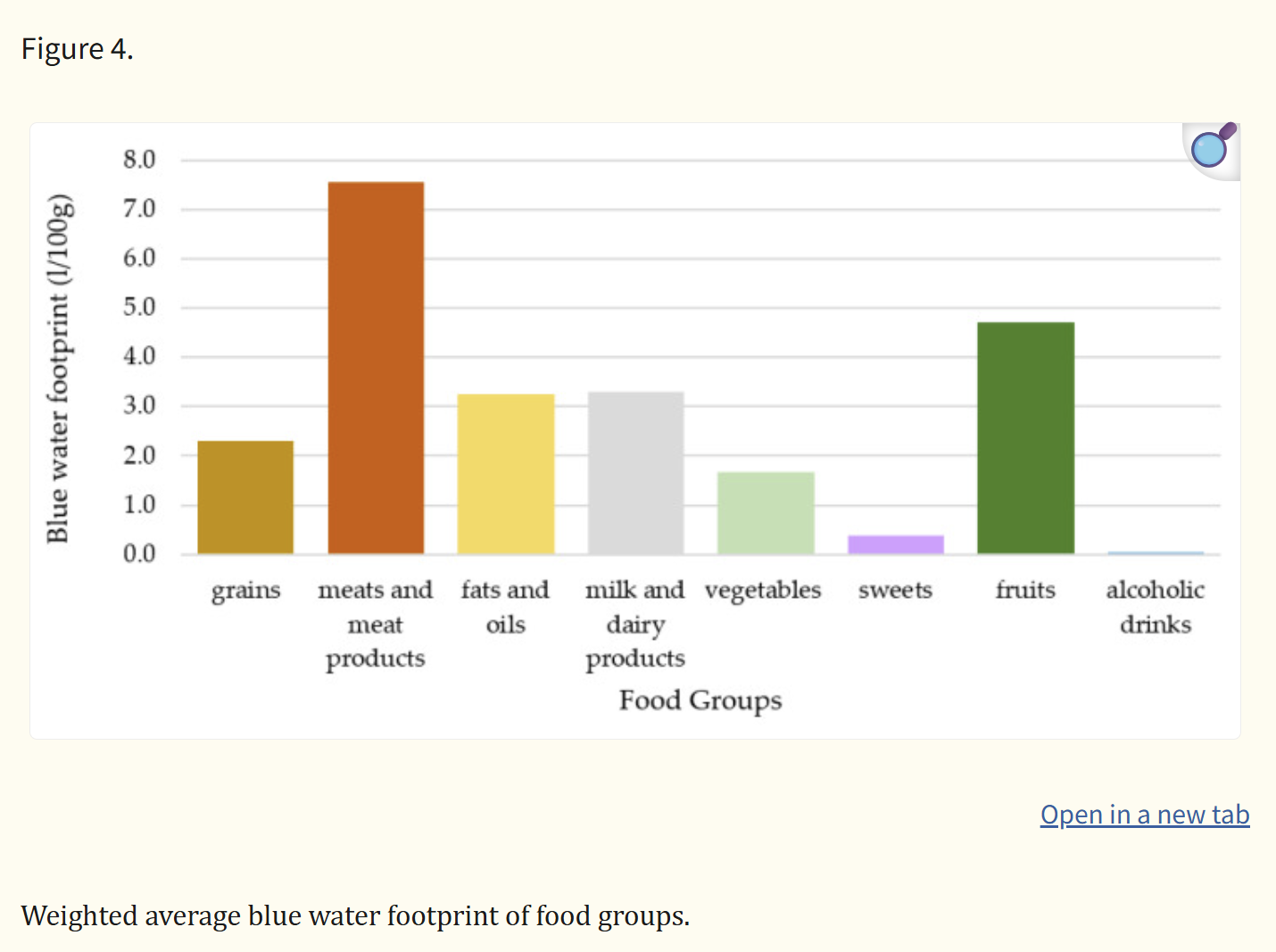
Before we go further into their study, we need to understand blue water and green water. I got this information from Polytechnique Insights:
Blue water is a visible water source. Think rivers, lakes, ponds, and so forth.
Green water is stored in the soil and in vegetation. I also imagine it accounts for any underground water storage, like aquifers.
Now, let’s note these two charts from PubMed Central. Meat and meat products consume the highest amount of both water types. For green water, fats, oils, and dairy products consume large amounts of green water, too, though slightly less for blue water. Fruits, on the other hand, consume a ton of blue water. Fascinating! But gains and veggies are low in both water types.
ScienceDirect summarizes their findings with “the overall water footprint of green water (soil moisture from precipitation) could be reduced by 26 % through the transition to non-animal-sourced diets. In contrast, the footprint of blue water (surface and groundwater) remained unchanged (Harris et al., 2020).”
Land Use
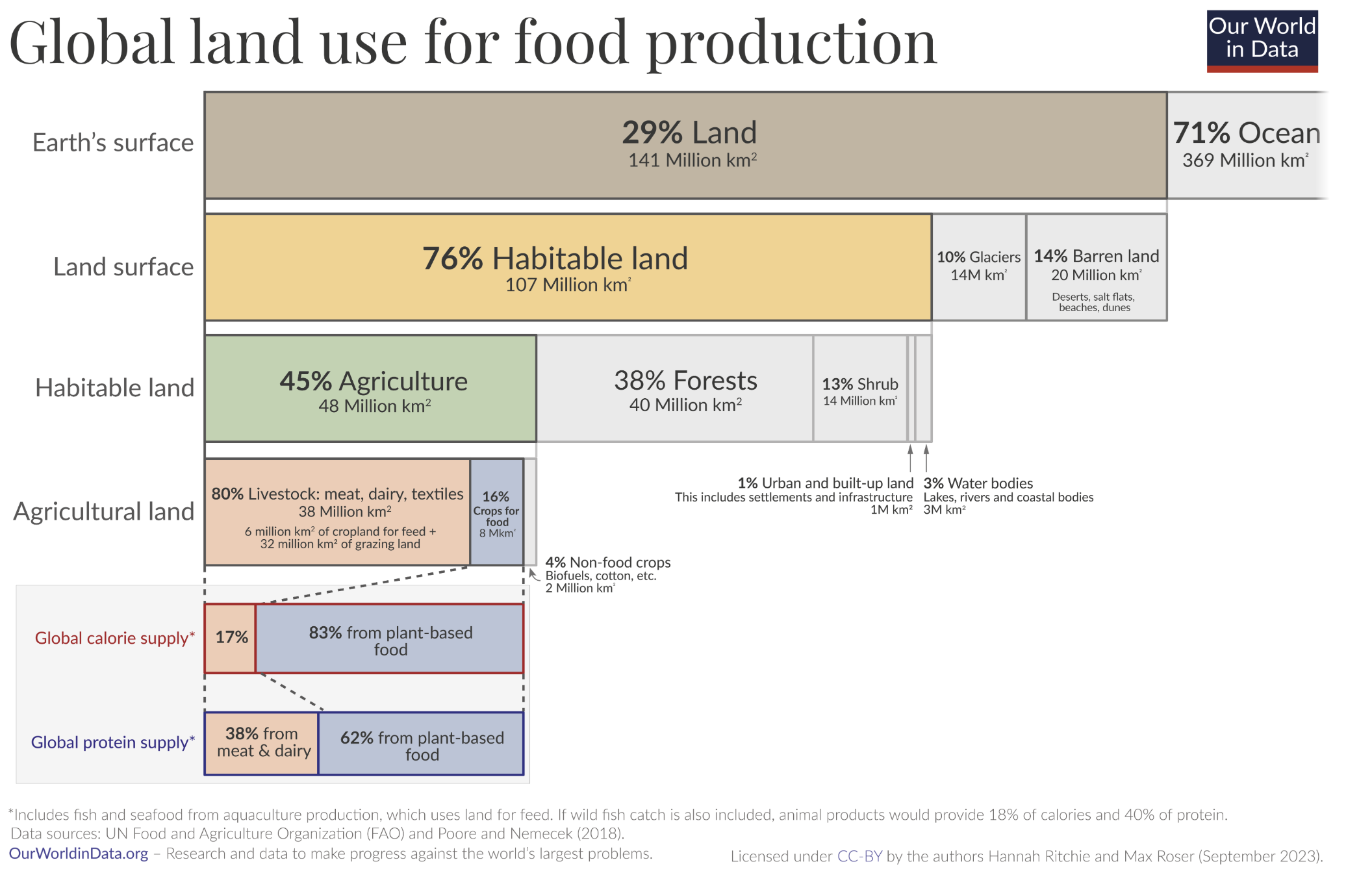
Animals need a lot of room to live, yes, but they need even more room to grow all of the food that they need to survive and get to an appropriate age to be killed for food. Our World in Data outlines that “44% of the world’s habitable land is used for agriculture. In total, it is an area of 48 million square kilometers (km2). That’s around five times the size of the United States. Croplands comprise one-third of agricultural land, and grazing land comprises two-thirds. However, only half of the world’s croplands are used to grow crops that humans consume directly. We use a lot of land to grow crops for biofuels and other industrial products, and an even more significant share is used to feed livestock. Livestock, therefore, accounts for 80% of agricultural land use, and food directly consumed by humans accounts for just 16% of agricultural land use.”
In a separate article, Our World in Data sheds light on how much we could shrink this land use if fewer animal products were consumed worldwide. They first explain that, “The land use of livestock is so large because it takes 50 to 100 times as much land to produce a kilocalorie of beef or lamb versus plant-based alternatives.” Not only this, but animal products only “contribute quite a small share of the global calorie and protein supply. Meat, dairy, and farmed fish provide just 17% of the world’s calories and 38% of its protein.”
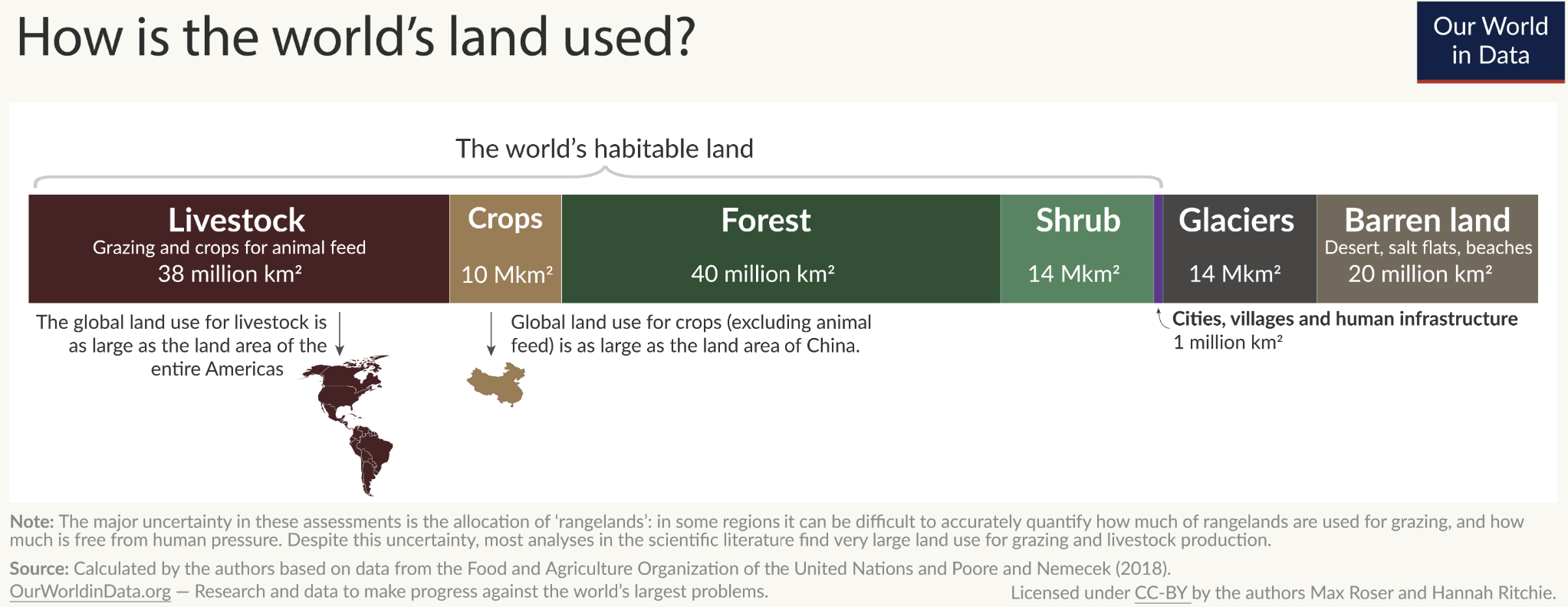
Of course, it’s also important to note that grazing land for livestock is usually unsuitable for farming, anyway. Our World in Data estimates that “livestock can be raised on pasture grasslands or on steep hills where it is not possible to grow crops. Two-thirds of pastures are unsuitable for growing crops.
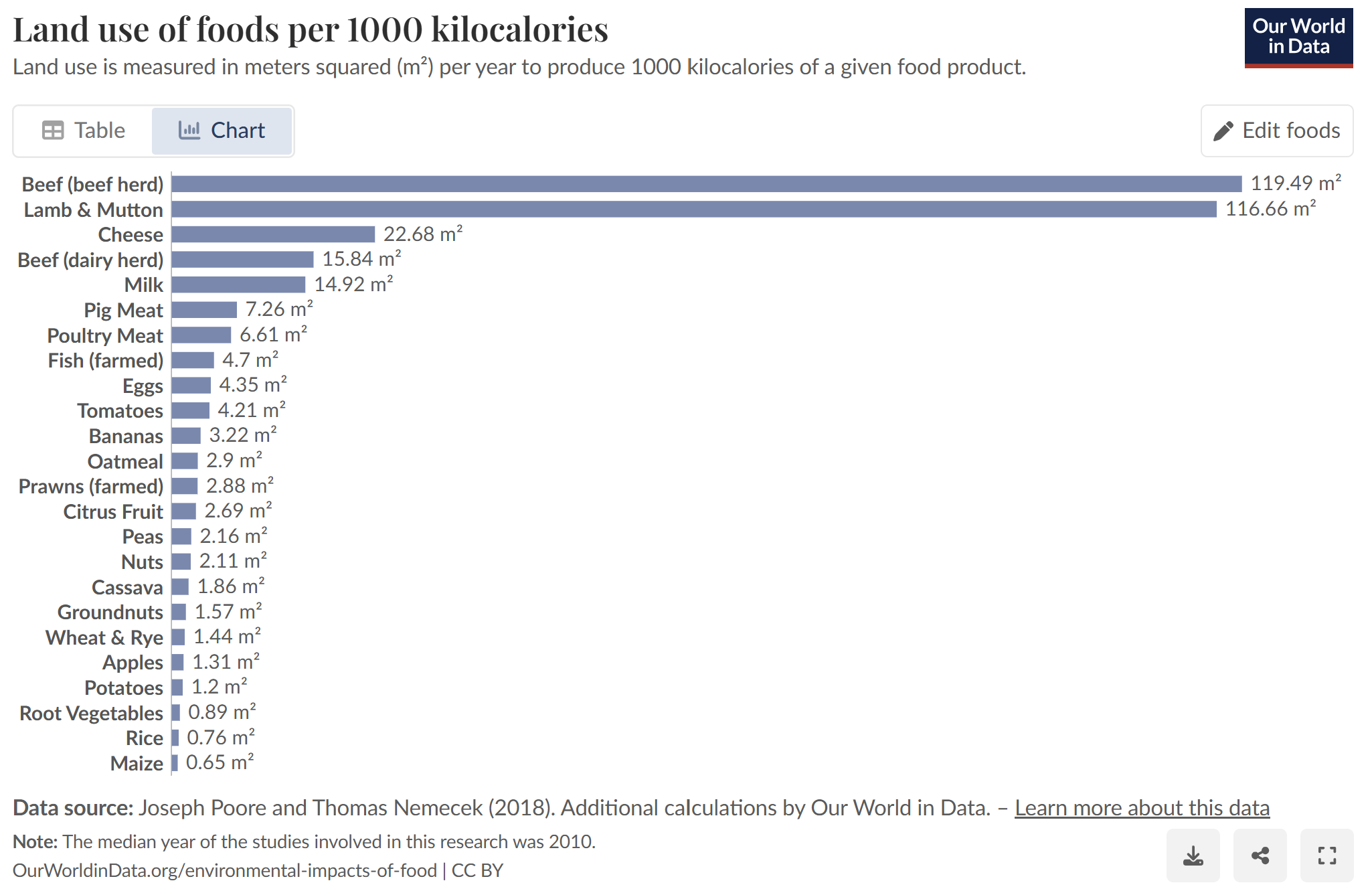
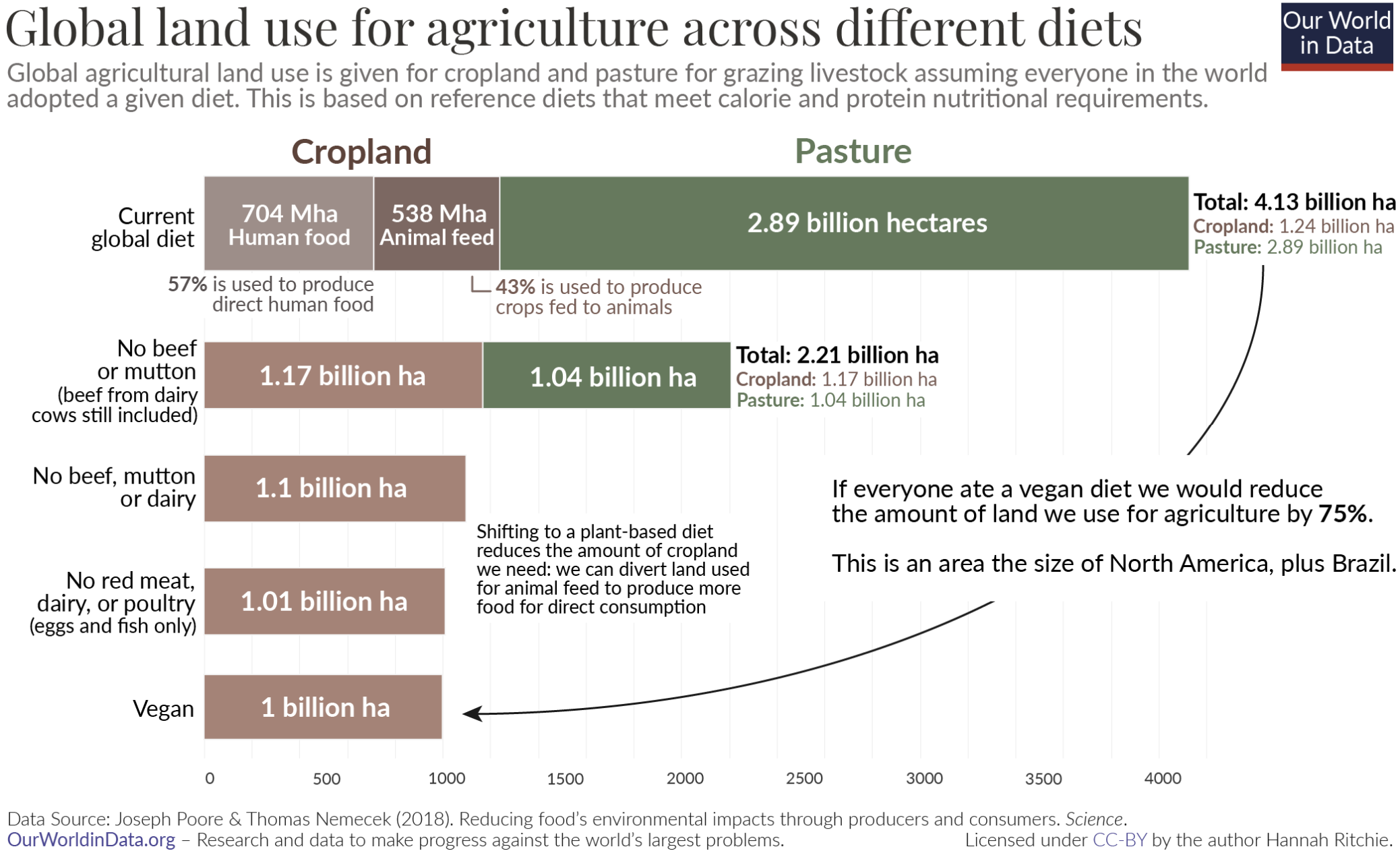
But, they further explain that “if we were to shift towards a more plant-based diet, we don’t only need less agricultural land overall, we also need less cropland. This might go against our intuition: if we substitute beans, peas, tofu, and cereals for meat and dairy, surely we would need more cropland to grow them? If we combine pastures and cropland for animal feed, around 80% of all agricultural land is used for meat and dairy production.”
This chart helps explain more.
Deforestation
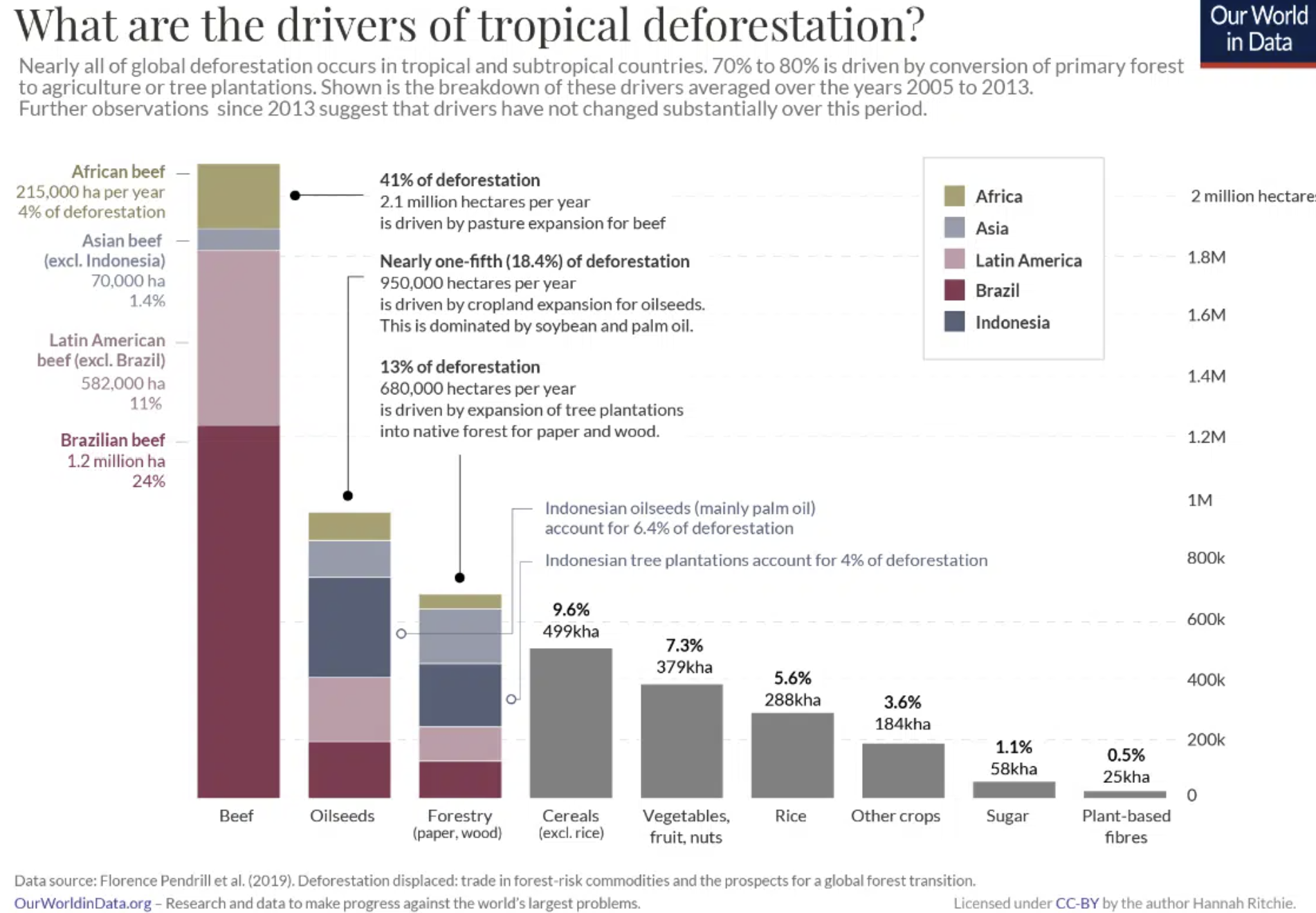
We already know just how much land animals take up, but when they take up that land, they destroy biodiversity and contribute to deforestation in the process. This is mostly due to having to grow crops to feed the animals. You can’t grow soybeans and corn in a forest; the trees have to go!
Broadly speaking, deforestation is a huge issue that has a number of causes. Earth.org explains that “every year since 2000, the world has been losing about 5 million hectares (20,000 square miles) of forest. The rate of species extinction globally has risen to unprecedented levels – up to a thousand times faster than natural rates.” They further explain that “at least 75% of this deforestation is attributed to agricultural activities, including the clearance of forests for crop cultivation, livestock grazing, and the production of commodities such as paper. But, the primary catalyst behind global deforestation is beef production, with the conversion of land for cattle grazing and feed production accounting for approximately 41% of deforestation.”
The anti-vegans are probably ready to type angrily again: “bUt thE NuMbEr oNe CaUse oF deFoReStaTiOn iS sOy ProDucTiOn.” Yes, for livestock feed. Earth.org states that “soy production, which is also one of the leading causes of global deforestation, is closely tied to beef production – remarkably, 80% of soy produced globally is fed to livestock, leaving only 20% for human consumption.” Is our tofu contributing to some level of deforestation? Yeah, most likely. As is the land for our cereals and breads. But we could greatly reduce that soy-based deforestation by eating fewer animal products, which rely on larger amounts of soy than we do to survive.
In summary
According to PubMed Central:
“The production of 1 kg of beans requires 3.8 m2 of land, 2.5 m3 of water, 39 g of fertilizer, and 2.2 g of pesticide; however, the production of the same amount of beef requires 52 m2 of land, 20.2 m3 of water, 360 g of fertilizer, and 17.2 g of pesticide, i.e., ∼8–14 times more resources are needed to produce the beef (24). Differences in the use of resources are observed not only by weight of foods, but also by their protein content. Comparing 1kg of protein from beef and beans, beef protein requires 18, 10, 12, and 10 times more land, water, fertilizers, and pesticides.”
The University of Oxford Medical Sciences Division found that vegans have a dietary footprint just 30% that of omnivores.
Truly, this is just the surface, but I hope you get the idea.
Image from Squarespace
The future of food
I’m still not saying that the entire world needs to go vegan. That would be great, but I know it’s not practical. I think we should all just consume fewer animal products. Just like with zero waste, we don’t need a handful of perfect vegans. We need a lot of people eating an imperfectly plant-based diet. This will reduce even more harm for the animals and the planet than if people never even tried a vegan burger because they think they can’t due to the fear of never being perfect. I talk more about this topic in this video.
Meat consumption is still on the rise, as seen in this chart.
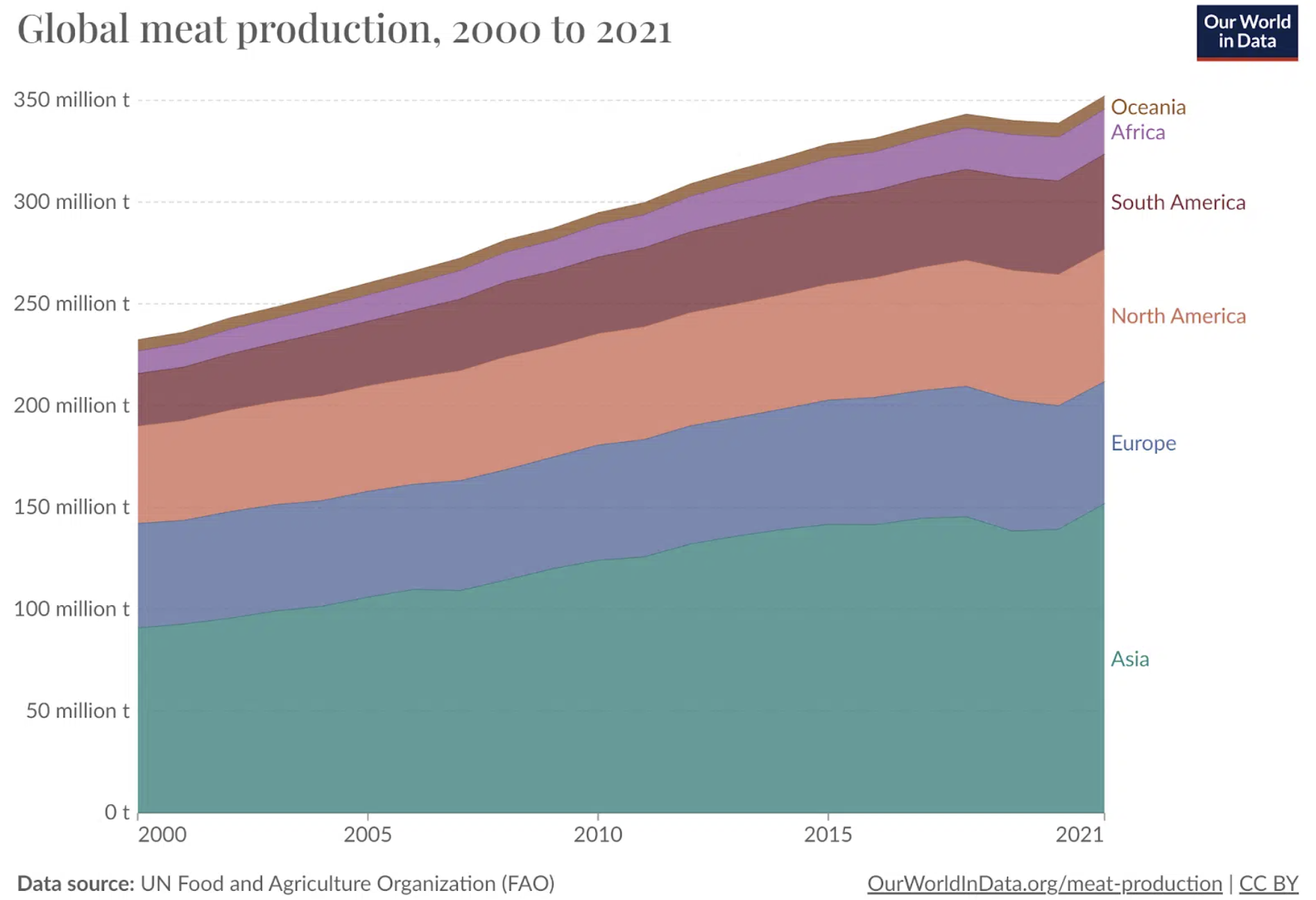
And especially now, since pseudo-scientist RFK Jr has flipped the food pyramid to encourage more meat consumption. I bet the meat industry paid a pretty penny for that! But other countries are doing their part to reduce meat consumption by removing subsidies for the meat and dairy industries and even imposing meat taxes to make it more expensive for farmers to raise the most impactful livestock like cows.
Plus, we didn’t even cover the other benefits of going plant-based, such as health benefits, it’s easier to compost plants than animal products, it’s easier to clean veggies than to sanitize after having flesh in your kitchen, the lack of zoonotic diseases that lead to pandemics and other disease spread, and so much more.
My tips for going vegan are much like my tips for going zero waste:
Start small. You don’t have to change your life overnight! Try one vegan day per week or veganize just one meal per day at the start. Maybe being vegan at home works for you, but not when you go out to dinner or to a friend’s house. That works, too!
Start with the most impactful areas. Beef is the worst, so see if you can just dial back the beef for now and move on to other foods later.
You don’t have to be perfect. If you “mess up,” it’s okay, just keep going! It’s much better to be 1% plant-based than 0%. Aim as high as it works for you.
Don’t go in ignorant. Do some research so that you meet your dietary needs, such as protein and caloric intake.
Beware of the increase in fiber! Many people quit meat cold turkey and get a stomachache on day one and then quit. Your body isn’t used to that much fiber, so take it slow!
If you don’t like a swap, try a different brand!
It doesn’t have to be expensive if you stick to whole foods like beans, veggies, fruits, and grains. It’s the vegan burgers and cheeses that add up!
Just try it! Let this be your sign to try that vegan recipe or vegetarian swap at a restaurant!
Let us know your tips for new vegans down below!
I hope this was informational and inspirational, too. We can make a difference through voting with our dollars. When I first went “vegan” around 7-ish years ago, there were so few options for vegan cheese and milk, and now we have an abundance of options that are all AMAZING. The select few options were also used to not be good. Back in the day, we had almost no options for zero-waste specialty items like sour cream, ice cream, heavy cream, eggs, and so forth. Now we have these more niche swaps. This is because our dollars matter. Companies saw how profitable it was to join the vegan market and do so with GOOD food, not just mediocre swaps. It pays off to take action!
Give a vegan swap a try this week, maybe it’ll stick for you and we can collectively work to make this planet a more sustainable place to be.
As always, remember that your small actions truly make a big difference in the long run :)
Emma
