

The Far-Reaching Impact of AI Data Centers on the Planet and Humans
Data centers. They’re all the rage right now. They’re popping up left and right, in big towns and in small ones, in left-leaning regions and in conservative ones. But our fights are paying off. Our actions matter so keep standing up to the tech oligarchy! More on what we can do at the end. I just wanted to set the tone to be hopeful, now, because things are about to get serious and even a little grim.
Trigger warning for climate anxiety, slave labor, and sexual assault.
Thank you for supporting work like this. Big tech platforms that I post on hate when I talk about this. Brands don’t want to partner with creators who talk about this. Your support and engagement help keep my channel going and help spread the word on this important information.
I’m going to keep it brief about AI and the environment for this post, so check out the eco impact of AI here to learn more.
Let’s get into it!
What is a Data Center?
According to American Rivers, “Data centers are big facilities that house servers, storage, networking equipment, and supporting infrastructure that power websites and other digital services people use every day. They are vital to everyday modern life, economic growth, and national security.”
That’s right. They’re not just used for AI. Though that is a large part of why they are popping up at an exorbitant rate, as AI is on the rise. But we need data centers to send emails, to write papers, to surf the web, to partake in social media, to store photos digitally, to stream music and shows, and almost everything we do online. They’re not new, but they are becoming an alarming problem as they pop up so fast and in every corner of the planet, it seems.
So, what is an AI Data Center?
According to Columbia River Keeper, “AI-specialized data centers cluster processors closer together to accelerate communication, which requires more cooling. Data centers range in size from a single room in an office building to massive, ‘hyperscale’ campuses.”
According to Cisco Systems, here’s how they differ from regular data centers: “Unlike traditional data centers used for general web hosting, they use high-density, specialized hardware like GPUs. They require massive amounts of electricity, robust cooling systems, and ultra-fast networking to process enormous datasets.”
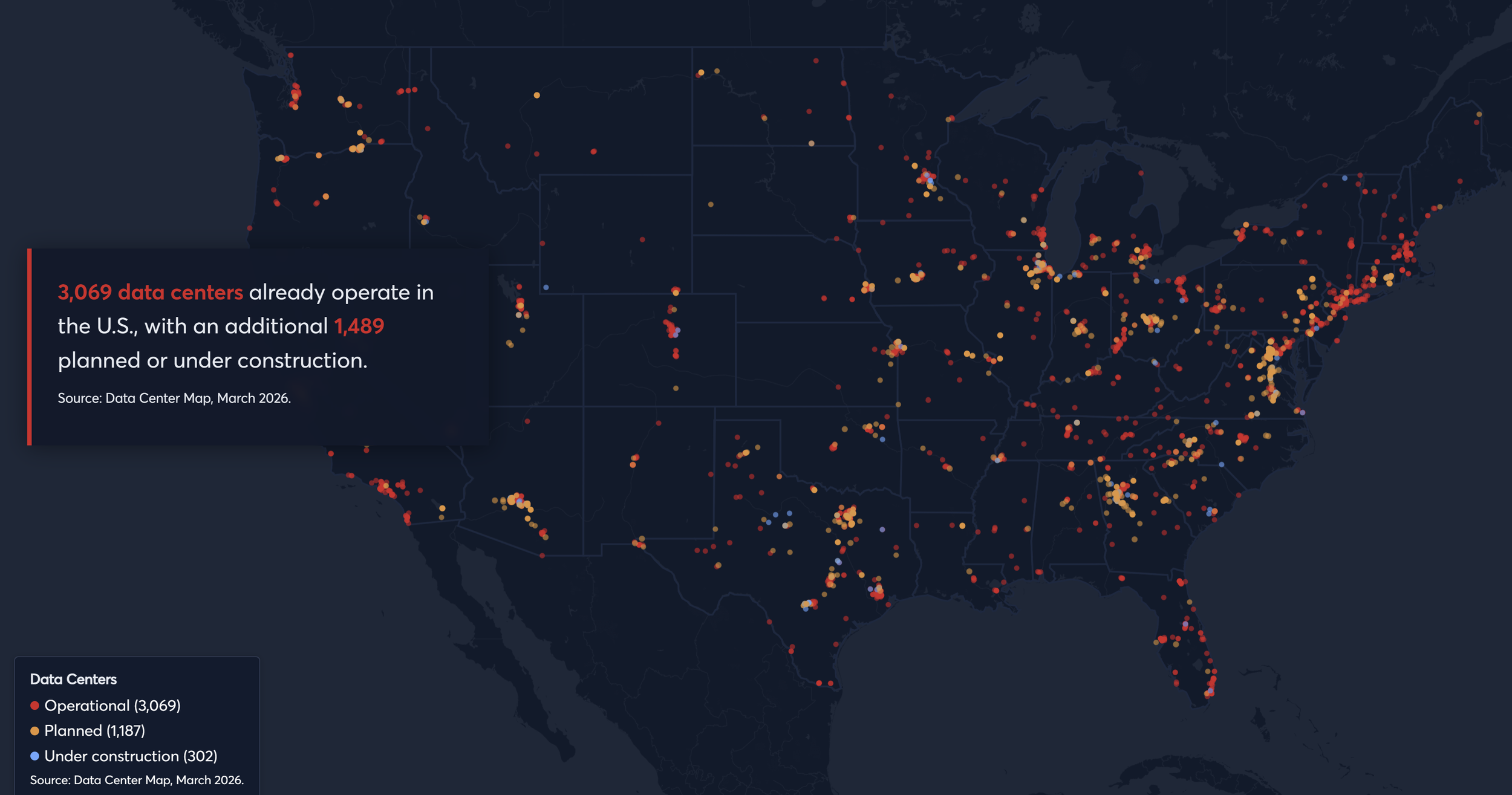
Check out this map of hyperscale data centers established and planned. Each uses the amount of energy as a small city, and many are being built in drought-ridden areas (like on Lake Mead) or in communities of color, a classic act ofenvironmental racism.
The Environmental Impacts of Data Centers
Now, why you’re all here. Let’s talk about how detrimental these are to the planet.
Water
I’m sure most people online have heard about how AI data centers use a massive amount of water and that that is the main environmental problem with data centers. It’s a big one for sure. But you may be surprised by the other categories to come.
Anyway, how bad is this water usage? Well, the Columbia River Keeper states that “A 1 GW campus consumes about 1 billion gallons of water per year, equivalent to the annual domestic water use of 25,000 people.”
That may be hard to picture. American Rivers put it into the perspective of just one day: “A single large data center can consume up to five million gallons of water per day — the same daily water use as more than 15,000 homes.”
If a data center is in your backyard, this impacts you directly. This is water you could be using in your home, using to water your garden, and are reliant on in times of drought.
Pollution
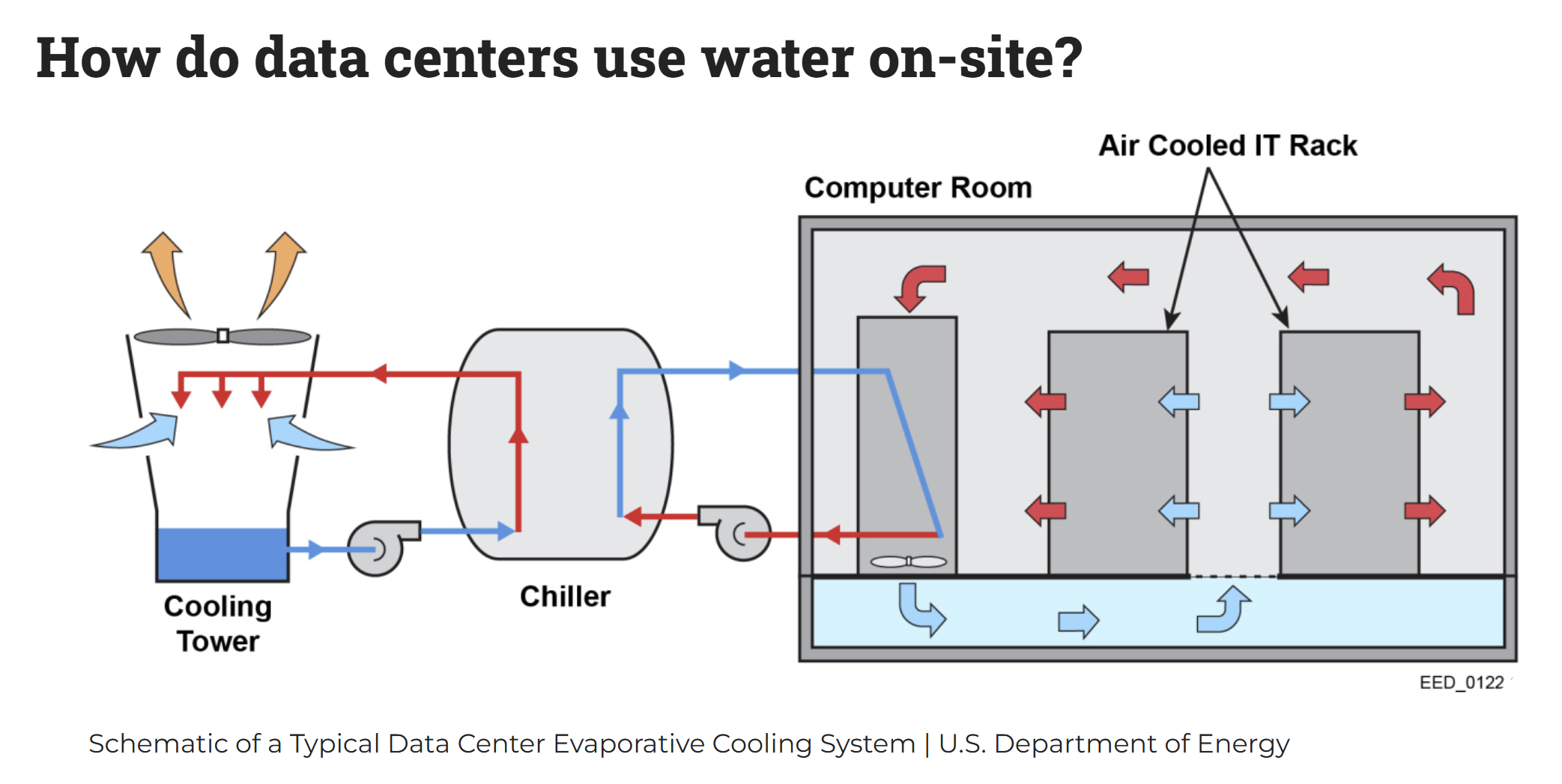
Forget water usage; AI data centers are also polluting any water they do release back into the environment. And it’s pollution that’s hard to tackle.The Columbia River Keeper states that these toxins and pollutants are not normally targeted by sewage treatment plants since they are currently designed to treat household waste, and waste from AI data centers is not household waste. These pollutants come from the cooling process. Computers get hot and they need to remain cool to operate.
These pollutants and toxins likely just end up in nature with no current mitigation efforts in place. This impacts you directly if a data center is in your backyard. That is water you drink, fish in, recreate in, and rely on for life.
Fossil Fuel Usage
AI Data Centers use a LOT of energy. Unfortunately, since the US is so behind on thegreen energy transition, largely in part due to oil subsidies (learn more here), these data centers are increasing the demand to burn fossil fuels and burn more of them. The Columbia River Keeper says that, “the projected energy consumption from data center development will nearly triple by 2029, outpacing planned growth of renewable generation.”
According to American Rivers, “Federal estimates show that electricity use by data centers has already more than tripled since 2014 and is projected to rise sharply again by 2028. In some regions, the projected electricity demand growth is expected to come almost entirely from data centers. To maintain operations during power disruptions, data centers often rely on on-site backup generators powered by diesel or natural gas, which contribute to local air pollution.”
The National Wildlife Federation explains that “data centers’ energy demands have driven some utilities to delay shuttering fossil fuel power plants and have prompted proposals to revive retired plants.” I can’t ignore that a key mission of the Trump 2.0 administration is “unleashing American energy.” And since this administration is paid for and operated by the tech broligarchy (namely Elon Musk, Peter Thiel, and Jeff Bezos), these have to be connected. See, once again, oil subsidies.
If an AI data center is in your backyard, this impacts you directly. That polluted air is now the air you must breathe and/or bear the brunt of the cost of rising energy prices and having to clean the air inside your home. More on that next.
Not only this, but this impacts every person on the planet as climate change accelerates. As of now, the United States is home to the greatest number of data centers in the world,according to Cloudscene. Everyone else on the planet will face the consequences of things they have no say in, no control over, and are thousands of miles away.
Wildlife
While there isn’t much data about the impacts of AI data centers on wildlife yet, we can do some speculation.
Large data centers require a lot of land. This leads to the loss of habitat and biodiversity across many landscapes and biomes. Deforestation is bad, but so is the loss of prairies, wetlands, and desert ecosystems.
Data centers are loud and bright. Noise and light pollution from cities and other industries have been known to affect wildlife, and specialists predict the same for AI data centers, too.
The air pollution from fossil fuels and polluted waters impact wildlife as well
In the PNW, it is estimated that data centers will prohibit the removal of dams, which will have a massive impact on the struggling salmon populations
And more!
The Economic Impact of Data Centers
You may have even noticed this yourself: gas, electric, and water bills are rising. This is partially due to the state of the world and the never-ending wars for oil, but it’s also because of AI data centers.
Why? Well, AI data centers need SO much energy. Consumer Reports states that, “because hyperscale data centers demand a nearly unimaginable amount of energy. The International Energy Agency says a typical hyperscale data center might use 100 megawatts (MW), as much electricity as 100,000 households.
And that’s at the low end. Meta’s Hyperion project in Louisiana, for instance, will need at least 5 GW to run. That’s three times as much electricity as the entire city of New Orleans, according to the Institute on Taxation and Economic Policy.
By 2028, data centers could use 12 percent of all the electricity consumed in the U.S., according to the Lawrence Berkeley National Laboratory, and that percentage will grow.”
Consumer Reports also cites a Bloomberg analysis. They say that “more data centers can mean higher costs. The analysis found that areas with high concentrations of data centers saw electricity prices jump 267 percent over the past five years.”
Not to mention, we will also have to pay with our tax dollars to clean up their mess: the air pollution, water pollution, loss of biodiversity, and the economic impacts of climate change, such as storm relief, will all be exacerbated by this boom of AI data centers.
The Ethical Impacts of Data Centers and AI
Who trains AI? Humans do. Have you ever done a Captcha to prove that you’re human? That was training AI to detect stop signs, stop lights, bikers, buses, and so forth. Have you participated in a trend that focused on facial expressions or vocal inflections? Though not proven, experts suggest that those trends are also used to train AI.
But that’s not all.
The London School of Economics and Political Science states that “nowhere are these disruptions felt more acutely than in the Global South. The Philippines and India are global hubs for outsourced customer support. They account for a significant share of the estimated 1.7 million call centre workers serving clients in North America and Europe. Similarly, Kenya has become a major base for AI data labelling, where workers earn as little as $1.50 to $2 per hour, reviewing harmful or graphic content to train moderation algorithms for platforms like Facebook and TikTok. Yet these same workers are being displaced as generative AI systems begin automating the very tasks they were hired to perform.
A vast majority of Global South workers remain locked out of this emerging AI economy, doing invisible “grunt work”. At the same time, companies and consumers in the Global North reap economic rewards.”
Of course, what about the hardware? The creation of batteries and computers also comes at the cost of literal lives in the global south, too. I cover more about the ethical impact of technology in this video, but in short, here’s more from the London School: “The physical infrastructure that makes this possible depends on extensive mining of resources like cobalt from the Democratic Republic of Congo, which produces over 70% of the global supply”
I highly recommend you read the full post from The London School. But in short, it comes down to exploiting people in the global south for physical labor, mental labor, and more while subjecting them to bodily harm, graphic images, and so much violence, all for little to no pay just so we can generate a photo of a dog on a trampoline. Keep that in mind the next time you’re tempted to use AI.
What can we do?
There is hope to be had! For me, my biggest hope lies in the fact that people of all different political parties and affiliations are against data centers for one reason or another. We can stand together and fight this fight on common ground.
Keep protesting, calling, writing, and signing petitions. It’s WORKING! Flock Camera (a video for another day if there’s interest) cancelled their LA contract after large public outcry. Data Center Watch estimates that “$64 billion of data center projects have been blocked or delayed amid local opposition.”
Local activism works! Show up to town halls to see if your city is planning to build a data center. If they are, speak your mind and encourage other community members to join you. When something like that happens in my city, my city council will put it to a vote instead of just deciding on their own…you know, like how democracy should work. I know this may not be commonplace everywhere, but this is how it should work. We the people should decide what happens in our communities!
If you see a petition about stopping data centers in your region (or any region), sign it. When data center projects go to vote, vote no!
And please keep talking about this stuff. Share this post and related video, talk about this with folks in your life who use AI, and keep educating yourself and others. It’s scary to confront people, but our livelihoods depend on it.
At the end of the day, also be mindful of your AI usage. Some of it is unavoidable as it happens behind the scenes, but I urge you to turn off AI features, cancel your ChatGPT membership, and especially stop using GenAI. More on how to boycott AI in this video.
Every small action we take absolutely matters. We have the power to make the world we want to see. A fair, equitable, and sustainable world for us all. They want us to feel hopeless. But seek out the good news and, if you have to, remain hopeful out of spite. We CAN do this.
Thank you for reading this deep, not-so-cheerful topic. It’s important to learn and be aware.
As always, remember that your small actions make a big difference in the long run :)
Emma
