

Everything To Know About Curbside Composting
I’ve been living zero waste for at least 8 years now, and I only started curbside composting a few months ago. I hope you see that as proof that you can live zero waste and join the zero waste movement even if you can’t do every single zero waste swap and habit!
But I still wanted to share what I’ve learned, what curbside composting is, how you can find one near you, and everything in between. And I’m going to be learning more soon as my area gets commercial composting, but that may be a long wait, so for now, let’s chat about this amazing small business I get to support!
What is composting?
First, we need to talk about what compost is and how we can make our own compost through the act of composting. The Natural Resource Defense Council puts it nicely:
“Composting is the natural process of recycling organic matter, such as leaves and food scraps, into a valuable fertilizer that can enrich soil and plants. Anything that grows decomposes eventually; composting simply speeds up the process by providing an ideal environment for bacteria, fungi, and other decomposing organisms (such as worms, sowbugs, and nematodes) to do their work. The resulting decomposed matter, which often ends up looking like fertile garden soil, is called compost. Fondly referred to by farmers as “black gold,” compost is rich in nutrients and can be used for gardening, horticulture, and agriculture.”
It’s keeping organic matter out of the landfill and is truly a form of recycling! Recycling food waste and yard scraps into soil/fertilizer again.

What is curbside composting?
Okay, so what is curbside composting then? In the simplest terms, it’s letting someone else handle the compost for you. You place your compostable items in a curbside bin that a company or an individual farmer comes to pick up and take to a composting site. So, yes, there are two different places that curbside compost may end up: a commercial composting site or a farm/backyard set-up.
Commercial Composting
Good Start Packaging describes commercial composting as, “Commercial or industrial composting uses the same biological processes as home composting food scraps and yard waste. However, it magnifies them on a much larger industrial scale. Using the latest technologies, companies can turn a broader range of organic materials into fertile soil than backyard composting. Items like compostable food packaging often require temperatures that can usually only be reached by these methods.”
Simply put, it is large-scale composting run by larger companies. It can handle large amounts of food waste, yard waste, and even sometimes bioplastics. Though, always double check before composting bioplastics in any compost setting. Check the product and the company doing the composting. Learn more about bioplastics here.
Small-Scale Curbside Composting
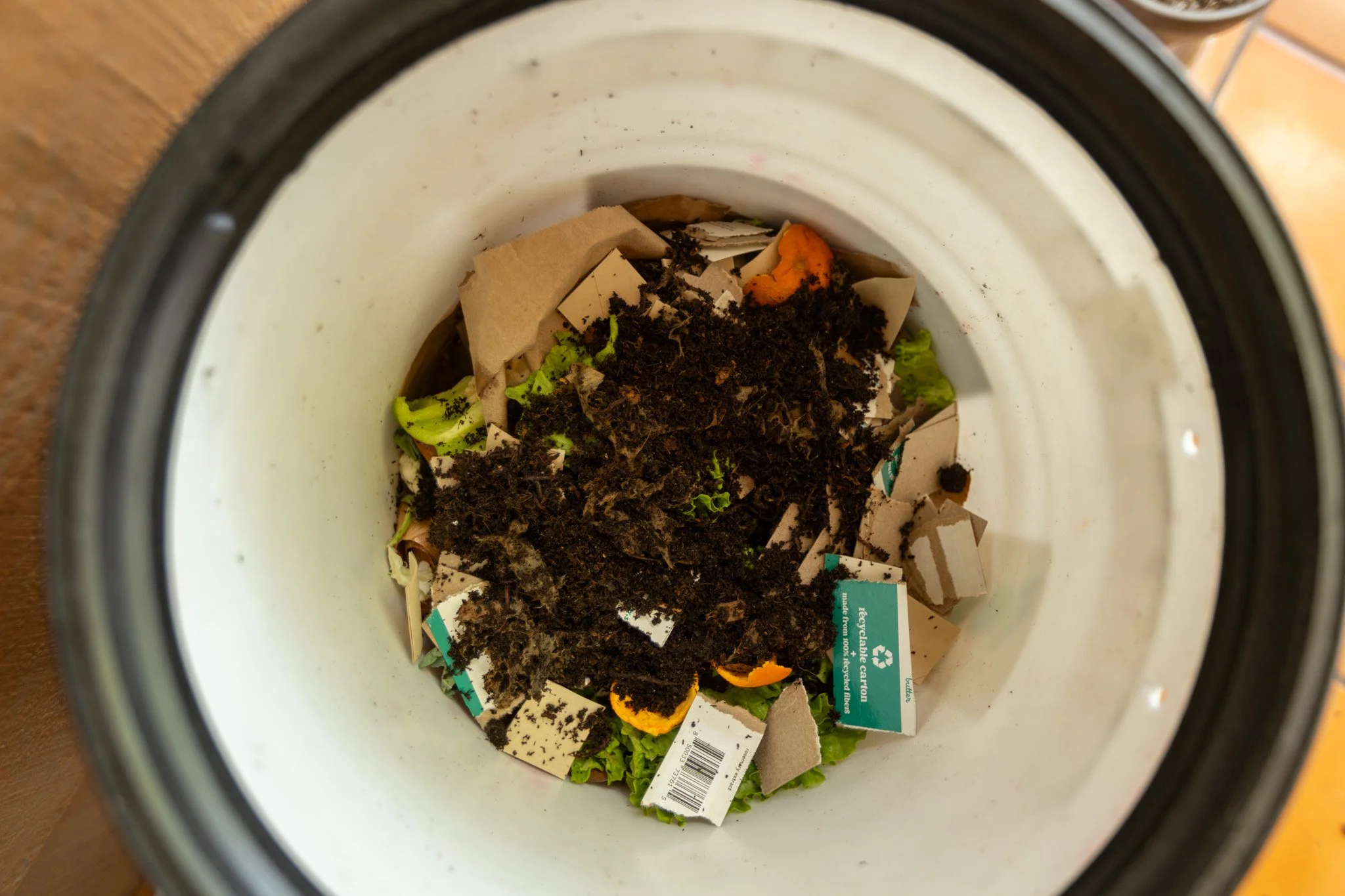
Our other form of curbside composting is small-scale. It’s done by individuals or small groups of farmers and community workers. This is the current method I use to compost. My bucket is small as they cannot handle the same volume as commercial sites, and they don’t accept bioplastics. But, it is still the same as backyard compost in that they take food scraps and turn them into that black gold! The difference is that I don’t have to do the work myself…I can pay someone else to do it!
How to find curbside composting near you
Does this sound like your preferred method of composting (check out 12 more ways to compost in this video)? Let’s see if we can find a curbside composting option near you!
My advice here isn’t terribly strong. I truly found my local option by accident! I was walking my dog, Denahi, on a new route that he took me on. I saw this bike with a longggg trailer with tubs on the back and thought “what in the world is that?” They had their logo on the back, and I saw that it was a bicycling curbside compost service! How cool!
Maybe you’ll discover yours by accident, too, but let’s see if we can find one on purpose.
First, try a simple Google or Ecosia search! Search for “curbside composting in [YOUR CITY].” For example, “curbside composting in San Francisco.” You may get some results like this. Click through the links and read their websites to see how you can get your own bin delivered and start curbside composting.
Now, to be honest, you’re not very likely to have a curbside composting option, especially if you live in a smaller town. If that’s the case, start to speak up about it! You don’t have to wait for things to change; you can BE the change. Go to town hall meetings and start to bring this issue to your city council. You can even go bigger and go to your state meetings and see if the state can mandate composting services to make it accessible for all of their residents.
Though that may take some time, so if you can’t curbside compost, head to the end of this blog post to check out my tips for composting in other ways!

How to curbside compost
Step 1: Acquire your bin and set up your billing
Once you’ve chosen a composting service, it’s time to get your bin. My current service lets me borrow a bucket with a downpayment. I pay $10 for the bucket, and I get my $10 back when I return the bucket. Though some services may offer you a free bin. It really depends! But you’re going to need a bin or bucket, so figure out how you’re going to get one from the service provider.
You will also need to set up your billing ahead of time, most likely. Most compost services are not free. I hope to see that one day, when composting is subsidized by the government! For now, though, figure out how you’re going to pay and how frequently. My provider is super small, so they only offer weekly pickup, even though ideally I would like to do every other week. You take what you can get!
Step 2: Familiarize yourself with the rules
Get on your compost provider’s website or give them a call to see what you can and cannot compost locally. They will also commonly provide you with a print-out of the rules when they drop off your bin. I keep mine pinned to our fridge in case I need to refresh what can and cannot be composted with my chosen service.
But generally speaking, you can compost:
Fruits and veg: rotten pieces, pieces you just won’t eat, peels, etc
Yard waste like grass clippings and leaves
Paper products such as tissues, paper towels, paper plates, and newspapers to name a few
Not all the time, but sometimes providers will also accept:
Leftover foods
Breads
Meat and other animal products
And very rarely will they accept bioplastics and biohazards, things like pet waste and human waste.
These are VERY generalized! Again, please check your local rules. It’s just like recycling in that every region and every individual facility is going to be different.
Step 3: Start gathering your compost
Now that you’re all set up and know the rules, it’s time to compost! Rather, it’s time to gather your compostable items so that someone else can compost for you. For me, I like to gather mine in the freezer. Sure, you can place them directly into your compost/green bin, but I don’t want my bucket to get all rotten and nasty. Then I would have to clean it more, and it’s just more work.
Keeping your items in the freezer until pickup day does take up space, but it greatly reduces rotting food in your bin, smells, and pests like fruit flies building up. Since my pickup is weekly, this only adds up to 1 or 2 gallon bags per week in the freezer, and thankfully, I have room for that. If you don’t have room for this, just place your compostables right into your compost bin and take it to the curb on compost day.
As another layer of precaution, I keep my bucket on my balcony and never indoors!
Step 4: Put your bin out on pickup days
Lastly, you just need to place your bin on the curb (or wherever they deem is best for pickup) on pickup days! My service told me the day for my community and a rough window of when to expect them. I just put it outside first thing in the morning so I don’t forget. My compost goes right from the freezer directly into the bin.
That’s it! Rinse and repeat to keep saving the planet. If you want to learn more about the importance of composting and why reducing food waste in landfills is so important, check out this video.
General tips:
When in doubt, do not compost bioplastics. They are complicated and very rarely accepted. You can call and ask about the rules, but it’s best to avoid composting them
Also, this should hopefully go without saying: don’t put trash or anything other than organic matter in your compost bin. Especially things like fruit stickers that can easily remain on an orange peel. Please be sure to remove them to avoid microplastics ending up in our soil.
Do not overfill your bin. It can be hard for the workers to remove the compost, and they give you a certain size bin on purpose: that’s all that they can manage. So be courteous of their rules
I’m going to emphasize it again: please follow the rules! Every region is going to be different, so I’m not sure what your rules are. I suggest calling or emailing your composting site with any questions you have.

How to compost in other ways
As I said in the beginning, I haven’t even had curbside composting services until now, and I’ve been living an eco life for over 8 years. But I’ve been composting since at least 2020! How?
There are so many options when it comes to composting. Here is a quick list, but you can learn more about each option in full in this video:
If you have yard space, just simply start a compost pile without having to build anything
Build or buy (secondhand is best) a designated compost bin. Here’s how I built one out of trash!
Try a “composting machine.” I have my issues with these machines, but I 100% see their purpose. I lived in an RV for 2 years, and it was the only way I could “compost.” I wouldn’t use these again in an apartment or house, but in an RV, it just made sense!
Farm drop-off. Some local farms, or homesteads, or even your local farmers’ market, may offer a drop-off service. This does require some work on your part, but hey, it saves the planet!
Try a worm bin! This can also be done indoors and in small spaces, but I do this on my balcony alongside the curbside composting, and a fun side quest if you will. Here is everything I learned as I failed at vermicomposting.
Bokashi composting is another great way to compost in small settings. This is technically fermenting your food waste! I have never dabbled in this, so be sure to check out other sources for more expertise.
And again, check out this full video for more ways that I think everyone can compost.
Thanks so much for reading along. I hope you found this valuable and helpful, and it inspires you to start your composting journey. I truly think that composting is one of the best things that we can all do for the planet!
As always, remember that your small actions make a big difference in the long run :)
Emma
